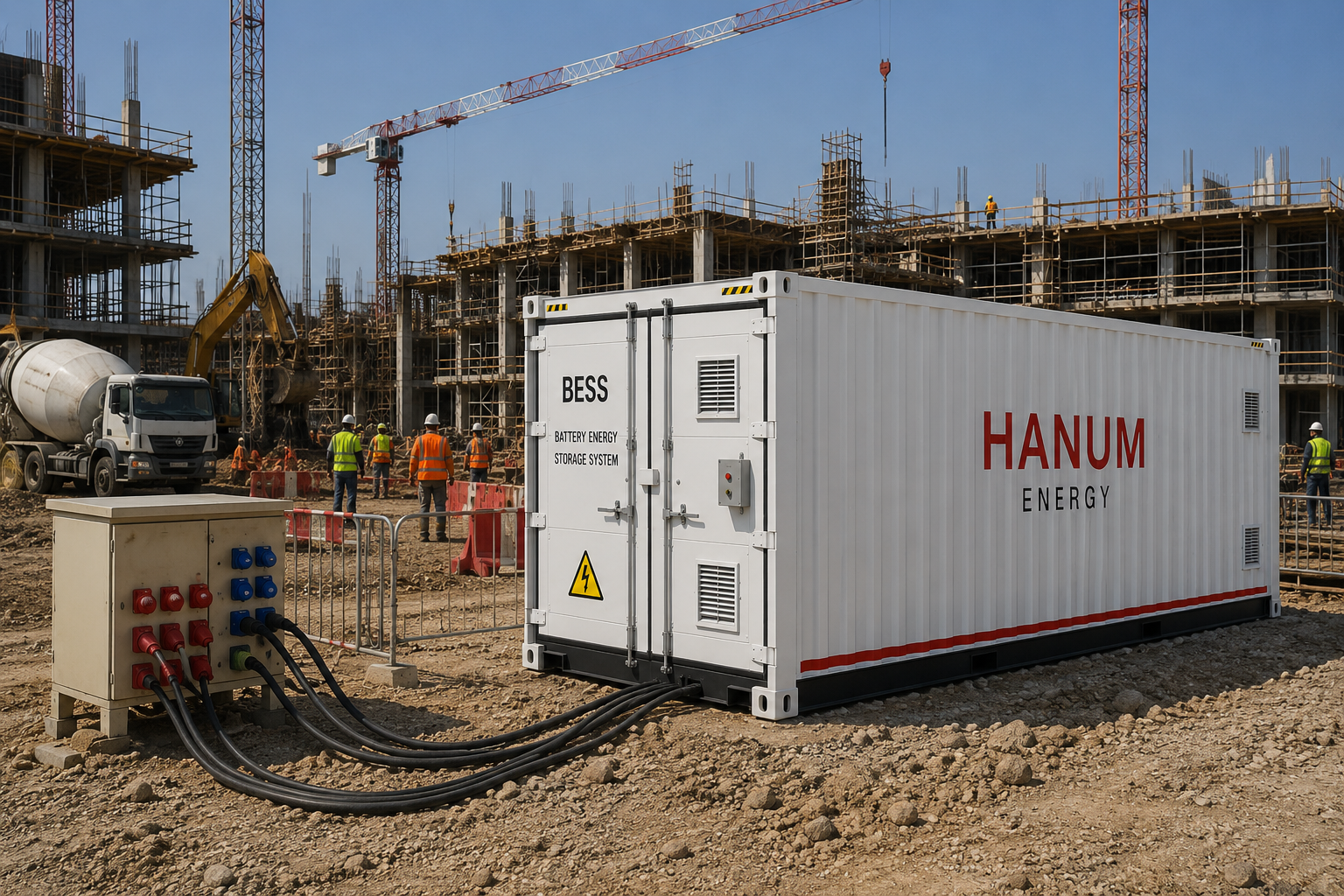
The challenge
Site gensets are sized for the single biggest load — the tower crane or concrete pump — but spend most of the day at 10–30% load, where diesels are inefficient, wet-stack, and burn fuel just to idle. Every running hour is fuel, servicing and wear, whether or not real work is happening.
In towns and cities the pressure is sharper: planning conditions cap night-time noise, low-emission zones tax or ban diesel, and clients increasingly want a low-carbon site. A battery lets the genset run only when it's genuinely needed — and not at all overnight.
Where storage pays off in Construction
Genset hybridisation
The battery carries the base load and peaks; the genset starts only to recharge it, running at its efficient full-load point. Typical sites cut fuel 30–60% and slash running hours.
Silent night & weekend working
Run on the battery alone for low-noise, zero-emission tasks — meeting night-time dBA limits and low-emission-zone rules in residential areas.
Crane & welfare power
Absorb tower-crane regeneration and carry welfare-cabin loads without bringing on a second generator just for the peaks.
Temporary-supply bridging
Cover the gap before the grid connection arrives, then shift to peak-shaving the builder's supply once it does.
What a Hanum deployment looks like
A towable or skid-mounted cabinet is parked beside the existing genset. Its controller auto-starts the genset only to top the battery up at optimal load, then shuts it down. As the build progresses and the grid connection lands, the same unit moves to peak-shaving the temporary supply.
| Form factor | Towable / skid cabinet |
| Pairs with | 1 site genset (any make) |
| Control | Automatic genset start/stop |
| Later phase | Peak-shave builder's supply |
Outcomes you can expect
- 30–60% less diesel burned across the programme
- Up to 70% fewer genset running hours — less servicing and wear
- Night-time noise & low-emission-zone compliance
- Lower hire and refuelling cost, and a low-carbon site for the client
At a glance
Common questions for Construction
Yes. The hybrid controller works with virtually any diesel set — it simply commands its start/stop and lets it run at the efficient load point. No need to change your generator supplier.
Lighting, welfare, small power, security and most fit-out activity run comfortably battery-only. Heavy simultaneous loads (crane plus pump) may still call the genset briefly; the controller handles that automatically.
Either. Many contractors take it on a managed lease for the duration of the build so it's an operating cost on the project, then hand it back. We'll quote both.
Recommended systems
Most sites use the Cabinet 125, stepping up to the Cabinet 500 for large projects with tower cranes and concrete pumps running together.
Put storage to work in Construction
Send us your load profile, tariffs and site details and we'll model exactly how a Hanum system performs and pays back for your operation — lease or buy.
Get a free consultation