The challenge
For a commercial tower or residential township, the demand charge and diesel-genset cost on common services are a permanent drain on the maintenance budget. When the grid fails, it's the lifts, fire pumps, security and common-area lighting that tenants notice first.
And leasing has changed: tenants increasingly expect EV charging in the basement and a recognised green rating (LEED, IGBC, GRESB). Both are hard to deliver on an ageing supply — storage helps with all of it at once.
Where storage pays off in Real Estate
Common-area cost reduction
Shave the building's demand peak and cut diesel-genset runtime on common services, lowering the recurring maintenance (CAM) charge.
Essential-services backup
Keep lifts, fire pumps, the BMS, security and common lighting running seamlessly through outages — silently, with no fumes.
EV-charging support
Buffer a basement charger bank so you can add EV charging without a costly grid-connection upgrade or a tripped main.
Green-rating & ESG contribution
Combine on-site storage with rooftop solar self-consumption to earn points toward LEED / IGBC / GRESB and tell a credible ESG story.
What a Hanum deployment looks like
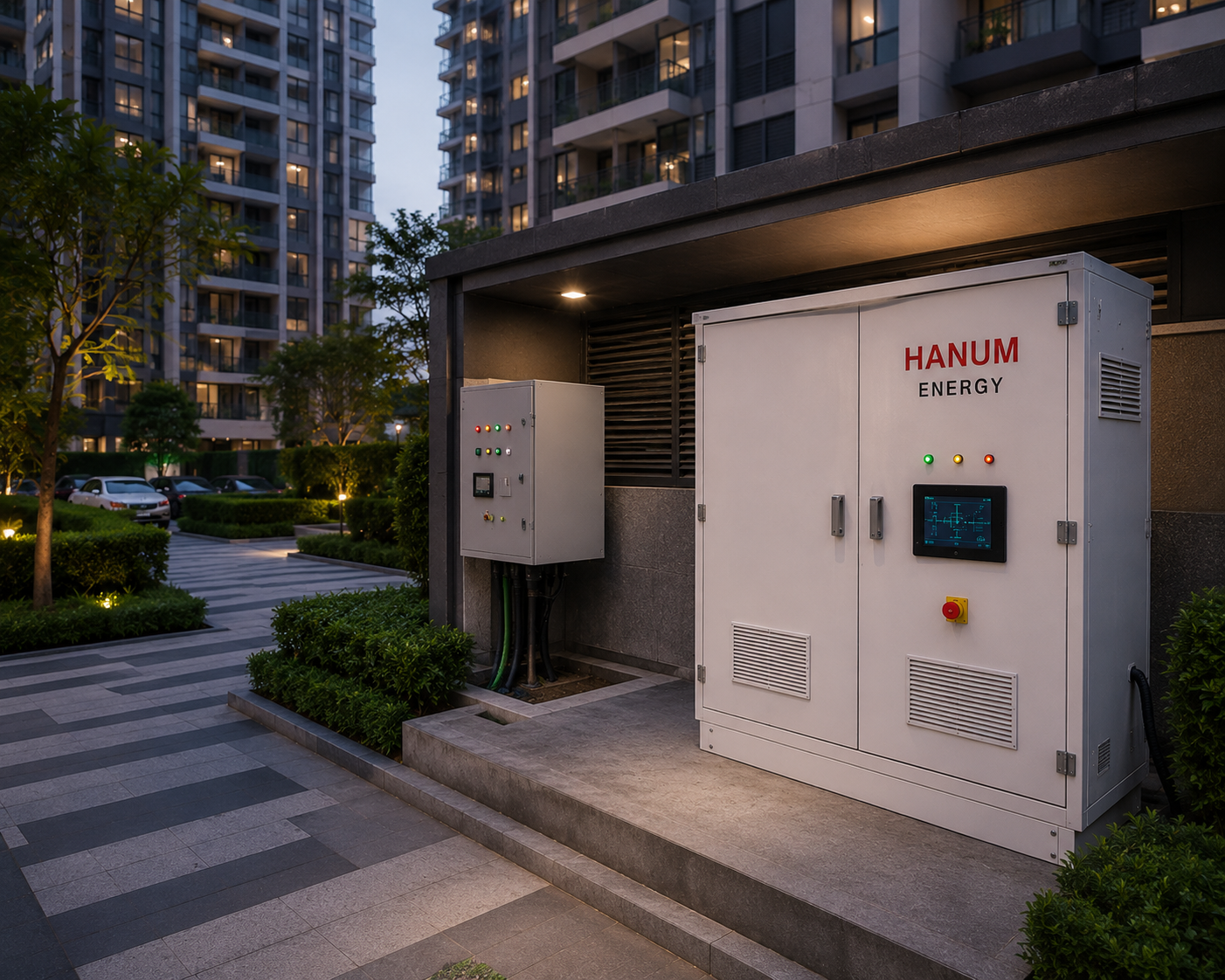
A cabinet in the basement or utility room sits behind the association meter, shaving the common-area peak and instantly backing essential services. It ties into rooftop solar and the EV-charger bank, all under one controller.
| Siting | Basement / utility room |
| Scope | Common-area peak + essential services |
| Adds | EV-charge buffer, solar self-use |
| Benefit | Green-rating contribution |
Outcomes you can expect
- Lower common-area (CAM) charges for every tenant
- Seamless backup of lifts, pumps, security and lighting
- EV-ready without a grid-connection upgrade
- Points toward LEED / IGBC / GRESB certification
At a glance
Common questions for Real Estate
Either — it's a sizing choice. Most owners back essential services (lifts, pumps, security, common lighting) for the best value, and can extend to fuller backup if the budget allows.
Yes. On-site storage with solar self-consumption and demand management contributes to energy and innovation credits in LEED, IGBC and similar frameworks. We can provide the performance data for your assessor.
Yes — that's a key driver. The battery buffers the charger peak so you can add fast charging on your existing connection instead of paying for an upgrade.
Recommended systems
Buildings use the Cabinet 125 or Cabinet 500, sized to the common-area load and the EV-charging you plan to add.
Put storage to work in Real Estate
Send us your load profile, tariffs and site details and we'll model exactly how a Hanum system performs and pays back for your operation — lease or buy.
Get a free consultation