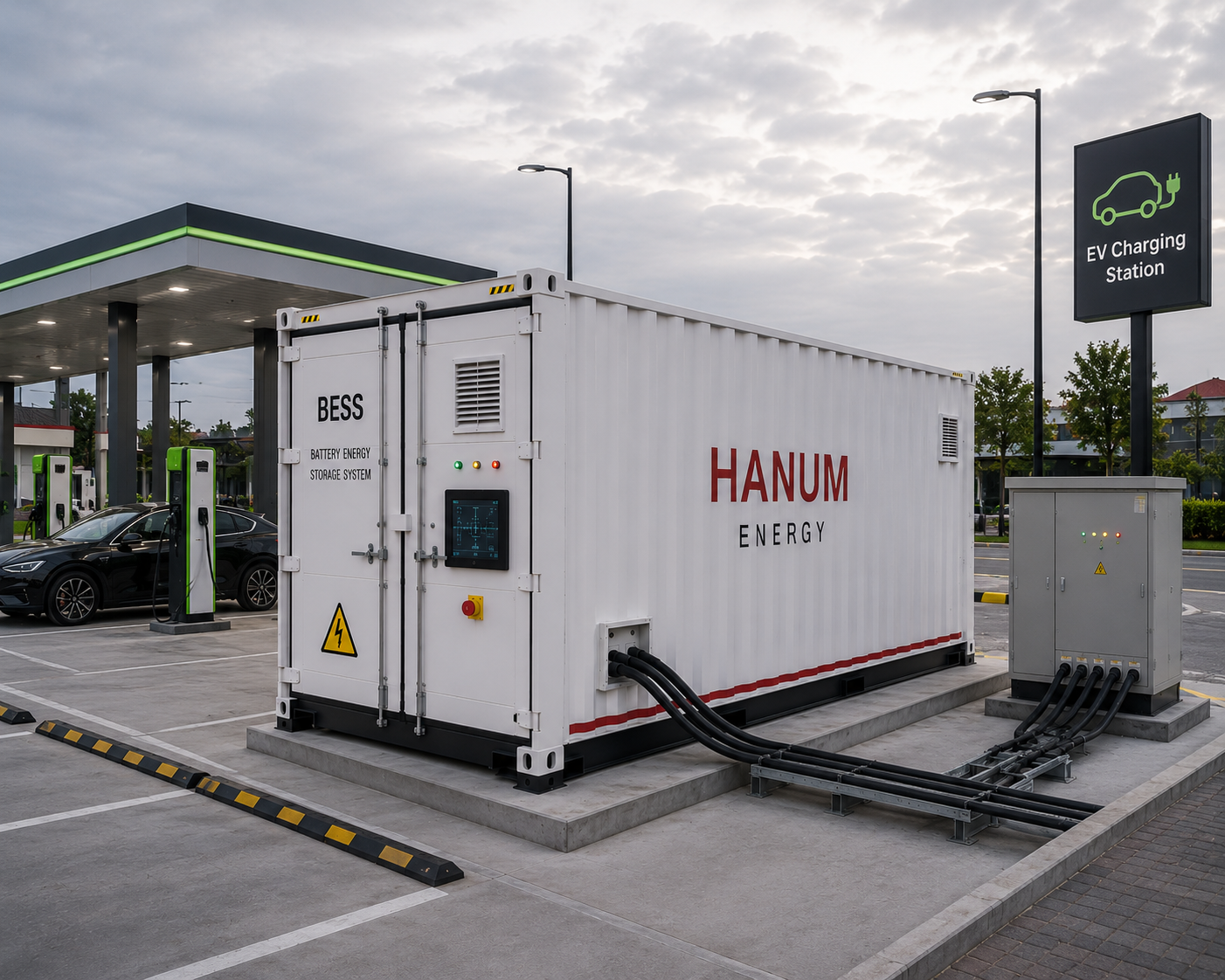
The challenge
A bank of 150–350 kW DC fast chargers can take a site from near-zero to a megawatt in seconds. The utility bills you for that peak as a demand charge, and a high-power connection upgrade can cost more than the chargers themselves — and take months of waiting.
At highway, rural and weak-grid locations the supply often simply isn't there. Storage decouples what you draw from the grid from what you deliver to the car.
Where storage pays off in Electric-Vehicle (EV) Charging
Demand buffering / peak-shaving
The battery supplies the charging spikes while the grid trickle-charges the buffer, so your connection — and demand charge — can stay small.
Grid-upgrade avoidance
Deploy 350 kW charging on a 100 kW connection, getting a site live in weeks instead of waiting on a utility upgrade.
Solar-plus-storage charging
Store cheap daytime solar and dispense it as cleaner, lower-cost kWh — improving margin per session.
Multi-stall load-balancing
Smooth and share power across several stalls so simultaneous sessions don't trip the main or starve each other.
What a Hanum deployment looks like
A cabinet sits between the grid connection and the charger bank. It charges slowly from the grid and any solar, then discharges fast into charging sessions; the energy-management system load-balances across stalls and protects the connection.
| Role | Demand buffer between grid and chargers |
| Pairs with | DC fast chargers + rooftop PV |
| Connection | Small or weak-grid sites OK |
| Control | Stall load-balancing EMS |
Outcomes you can expect
- Avoid six-figure grid-connection upgrades
- Demand charges slashed by capping grid draw
- Deploy on weak or rural connections in weeks, not months
- Greener, lower-cost kWh from stored solar
At a glance
Common questions for Electric-Vehicle (EV) Charging
The battery, not the grid, supplies the burst. Between sessions the grid slowly refills the battery at a low, steady rate — so a modest connection can support far higher peak charging power.
Yes, and it's ideal. The battery stores midday solar and dispenses it during charging peaks, cutting both your energy cost and your carbon per session.
We size the battery and grid feed to your expected session frequency so it's ready for the next vehicle. Busy highway sites get a larger buffer and feed than a low-traffic destination charger.
Recommended systems
Charging sites use the Cabinet 125 or Cabinet 500, sized to your charger power and connection limit.
Put storage to work in Electric-Vehicle (EV) Charging
Send us your load profile, tariffs and site details and we'll model exactly how a Hanum system performs and pays back for your operation — lease or buy.
Get a free consultation