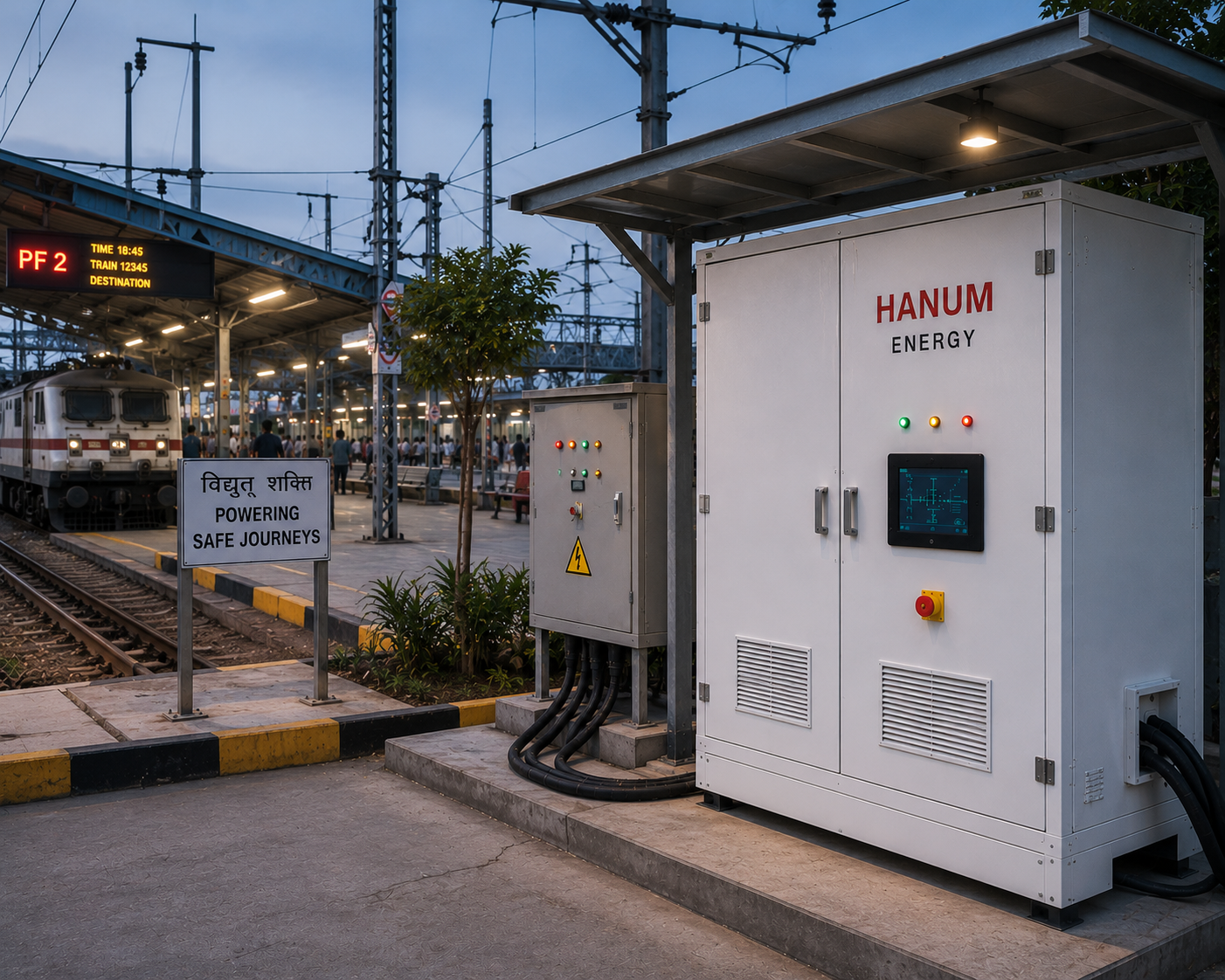
The challenge
Electric traction wastes a remarkable amount of energy. A braking train regenerates power, but with nothing on the line to absorb it, that energy is either burned off in resistors or pushes the line voltage dangerously high. Traction substations then face sharp demand peaks every time trains accelerate.
At the same time, signalling, level crossings and stations are safety-critical loads that cannot be allowed to lose power. Storage solves the energy waste, the peaks and the resilience together.
Where storage pays off in Railways & Transport
Regenerative-braking capture
Store the energy from braking trains at the substation and reuse it for the next acceleration — typically cutting net traction energy 10–30%.
Substation peak-shaving & voltage support
Flatten acceleration peaks and hold line voltage within limits, deferring expensive substation upgrades.
Signalling & station backup
Provide zero-gap power to signalling, crossings and station systems so safety functions never fail.
Depot & yard charging
Buffer fast-charging of battery trains and electric buses at depots without a connection upgrade.
What a Hanum deployment looks like
A trackside or substation container connects to the traction bus, absorbing regeneration and supporting voltage, while separate cabinets back up signalling and station loads. The configuration follows whether your traction supply is DC or AC.
| Siting | Traction substation / trackside |
| Captures | Regenerative braking energy |
| Supports | Line voltage + acceleration peaks |
| Also | Signalling / station backup |
Outcomes you can expect
- 10–30% traction energy recovered from braking
- Acceleration peaks flattened at the substation
- Substation upgrades deferred
- Fail-safe power for signalling and stations
At a glance
Common questions for Railways & Transport
Both — the connection and converter differ, but the principle is the same. We configure the system for your DC third-rail / overhead or AC traction supply.
On a busy line with frequent stops, recoverable regeneration is large; net traction energy savings of 10–30% are realistic depending on timetable density and gradient profile.
Yes. Safety-critical signalling and station loads are backed by dedicated cabinets, electrically separate from the traction-energy system, so resilience is independent of the energy-saving duty.
Recommended systems
Railways use the Container 5000 for traction-substation duty, with Cabinet 125 units for signalling and station backup.
Put storage to work in Railways & Transport
Send us your load profile, tariffs and site details and we'll model exactly how a Hanum system performs and pays back for your operation — lease or buy.
Get a free consultation