The challenge
Ports concentrate some of the spikiest loads anywhere. STS and RTG cranes draw and regenerate megawatts with every move, reefer yards run around the clock, and berthed ships idle on diesel auxiliary engines — a major source of local SOx, NOx and particulate pollution next to communities.
Regulation is closing in: shore-power mandates, plus shipping-line obligations under CII and EEXI, are forcing ports to offer clean berths and cut emissions. Storage is what makes that practical without a massive grid reinforcement.
Where storage pays off in Ports & Maritime / Shipping
Shore power / cold-ironing buffer
Supply hotel load to berthed vessels so they shut down auxiliary engines; the battery firms the connection peak and protects the grid during connect/disconnect.
Crane peak-shaving & regen capture
Store the energy STS/RTG cranes regenerate when lowering, and buffer their peaks to cut the grid connection — and retire diesel RTGs.
Reefer & terminal backup
Keep refrigerated containers and terminal operations powered through any interruption, protecting cargo.
Remote-terminal microgrid
Form an islanded microgrid with solar and storage for jetties and terminals beyond a strong grid.
What a Hanum deployment looks like
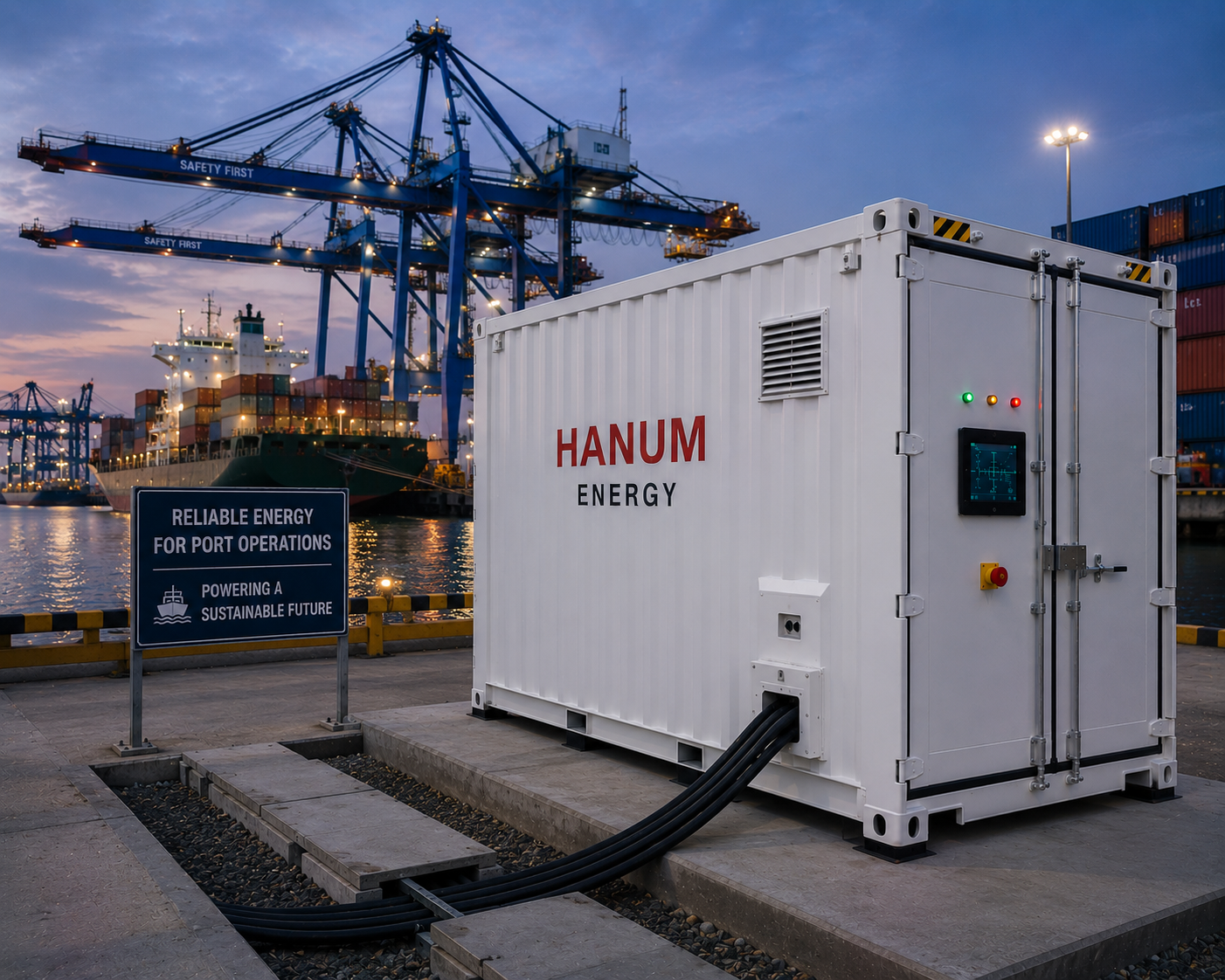
Containerised storage is sited at the quay and tied into the HV ring, between the grid and the cranes and shore-power connection points. It captures crane regeneration and firms shore-power demand, scaling across a whole terminal.
| Siting | Quayside, on the HV ring |
| Duty | Shore power + crane peaks |
| Captures | STS/RTG regenerative energy |
| Scale | Multi-MW, modular |
Outcomes you can expect
- Cold-ironing enabled so ships switch off at berth
- Local SOx / NOx / PM emissions cut at the quay
- Smaller grid connection despite crane and reefer peaks
- Diesel-free crane operation with regen recovered
At a glance
Common questions for Ports & Maritime / Shipping
Yes. The system firms and buffers the shore-power connection so berthed vessels can take hotel load from shore and switch off auxiliary engines, even with the large connect/disconnect transients involved.
It does — STS and RTG cranes regenerate significant energy when lowering loads. The battery stores that instead of burning it in resistors, and reuses it for the next hoist.
Yes. Containers are deployed in parallel on the HV ring and sized to the combined crane, reefer and shore-power load of the terminal.
Recommended systems
Ports deploy the Container 5000 in multiples, sized to crane, reefer and shore-power demand.
Put storage to work in Ports & Maritime / Shipping
Send us your load profile, tariffs and site details and we'll model exactly how a Hanum system performs and pays back for your operation — lease or buy.
Get a free consultation