The challenge
Two things on a factory bill do real damage. The first is the demand charge, set by your single worst 15- or 30-minute peak — one simultaneous start of big motors can define the charge for the whole month. The second is the cost of stoppages: a momentary voltage sag trips VFDs, PLCs and contactors, and restarting a line can cost a shift's output and scrapped work-in-progress.
On top of that, customers and regulators now want evidence of decarbonisation — RE100 commitments, Scope 1 and 2 reporting — which is hard to deliver when rooftop solar only offsets the day shift.
Where storage pays off in C&I Factories
Demand-charge management
Discharge into your demand peaks to cap the billed maximum, flattening the half-hourly profile that sets your kVA/kW charge.
Sag & outage ride-through
Sub-10ms switchover holds the line through dips and outages, protecting VFDs, PLCs and motors from the trips and restarts that cost real money.
Solar self-consumption & RE matching
Store rooftop generation to power evening and night shifts, pushing self-consumption past 80% and backing up your Scope-2 claims.
Time-of-use arbitrage
Charge on cheap off-peak energy and run on the battery through peak-tariff windows.
What a Hanum deployment looks like
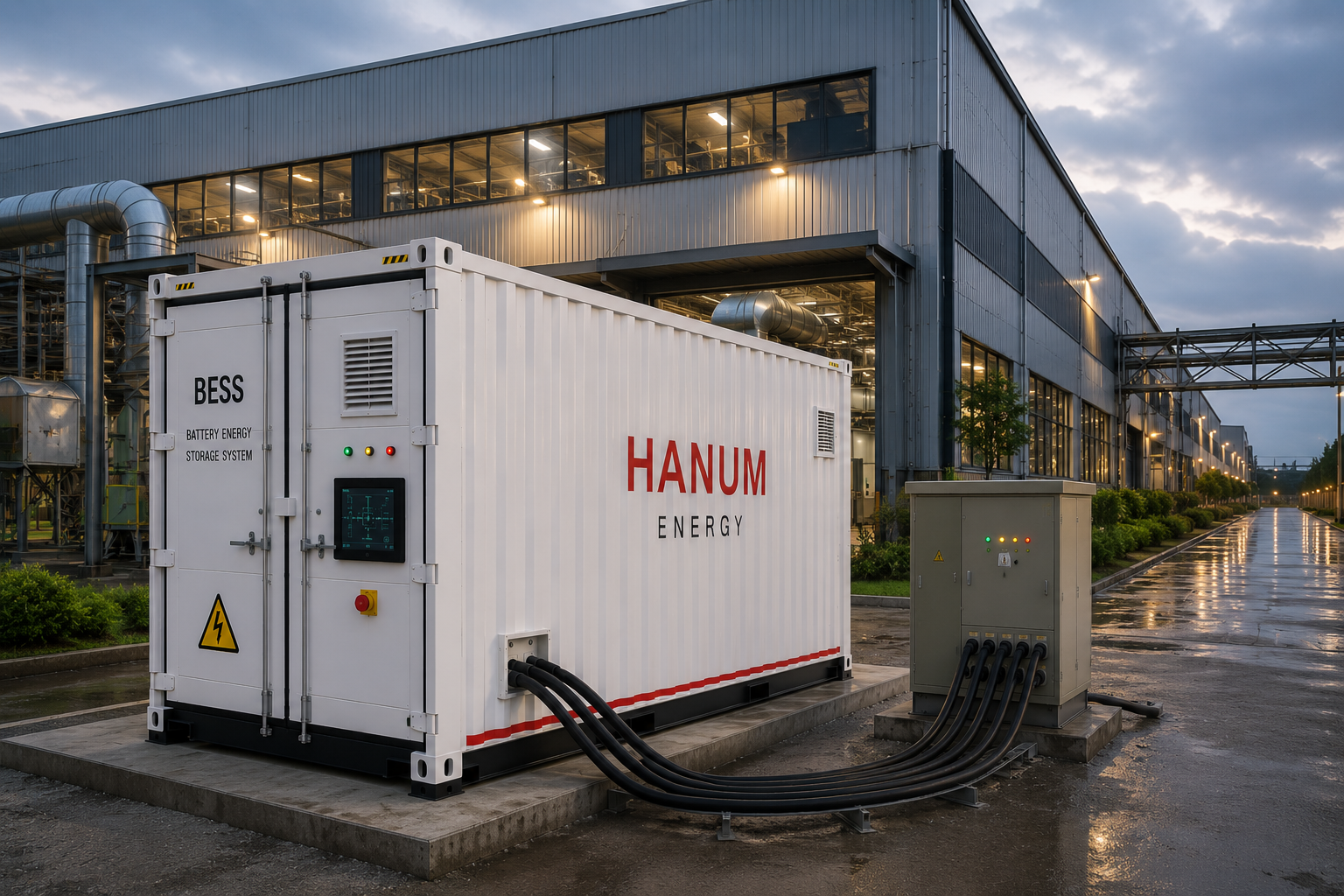
A liquid-cooled cabinet or bank sits behind the meter at your LT or HT panel. An energy-management controller watches both the demand window and the incoming supply, discharging on peaks and bridging dips automatically — no operator action required.
| Connection | Behind-the-meter, LT or HT panel |
| Mode | Peak-shave + dip/outage ride-through |
| Cooling | Liquid-cooled for daily cycling |
| Control | Demand / energy-management controller |
Outcomes you can expect
- Demand charges cut materially by capping your billed peak
- Zero dip-induced line trips — no lost shifts or scrapped batches
- Solar self-consumption pushed past 80%
- Documented Scope-2 reductions for customer and regulatory reporting
At a glance
Common questions for C&I Factories
It depends on how peaky your load is — the spikier the profile, the bigger the saving. We analyse a few weeks of your half-hourly meter data and size the system to your specific peaks before quoting a number.
It can reduce reliance on both. For critical lines it acts as instant ride-through (where a genset is too slow), and it can shorten genset runtime. We map it to your existing backup rather than ripping it out.
For factories it's almost always behind-the-meter, optimising your own bill. We can also configure front-of-meter participation where your grid pays for services.
Recommended systems
Most plants use the Cabinet 500; large or multi-line factories step up to the Container 5000.
Put storage to work in C&I Factories
Send us your load profile, tariffs and site details and we'll model exactly how a Hanum system performs and pays back for your operation — lease or buy.
Get a free consultation