The challenge
A solar farm dumps its whole output into the middle of the day, when demand and prices are lowest, then falls to zero by the evening peak. Wind is more violent still — output can swing megawatts in minutes. Grid operators respond with curtailment orders (you earn nothing for the energy you spill) and ramp-rate or grid-code penalties when your output moves too fast.
The result is a plant that produces most when energy is cheap and least when it is dear. Storage closes that gap: it captures the energy you would otherwise clip or curtail and releases it into the hours that actually pay.
Where storage pays off in Renewable Power Producers
Curtailment & clipping capture
Store the energy above your inverter or grid-export limit instead of spilling it, then sell it later — recovering MWh you are currently giving away for free.
Ramp-rate control & smoothing
Hold output within grid-code ramp limits and smooth cloud- and gust-driven swings, so you avoid penalties and pass interconnection compliance.
Time-shift & arbitrage
Move midday solar or overnight wind into the evening demand peak, lifting the average price you capture for every MWh produced.
Ancillary & capacity services
Provide fast frequency response, reserves and reactive power to open additional revenue streams beyond energy sales.
What a Hanum deployment looks like
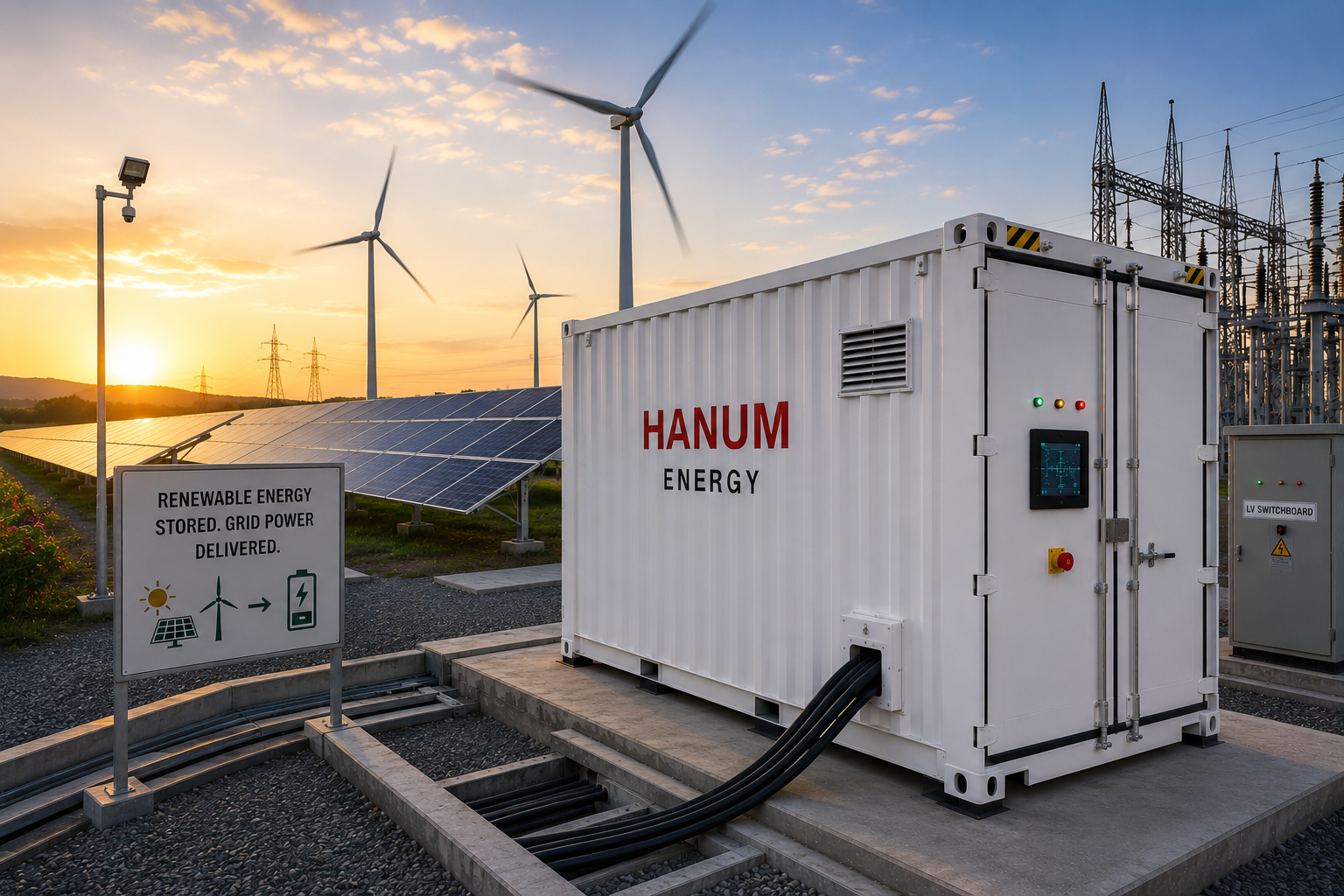
A containerised array is sited at the plant substation, AC- or DC-coupled to your inverters, and sized to a few hours of your typical clipped and shoulder energy. A plant controller charges it from clipping and price troughs and discharges it into the evening peak while holding grid-code ramp and voltage limits.
| Coupling | AC- or DC-coupled at the PSS |
| Duration | 2–4 hours (project-specific) |
| Control | Plant controller + grid-code firmware |
| Scale | Multi-MW / multi-MWh, modular |
Outcomes you can expect
- +10–20% revenue per MWh by shifting energy into premium evening hours
- Curtailment and clipping losses recovered instead of spilled
- Grid-code ramp & voltage compliance at the interconnection
- Eligibility for ancillary and capacity markets as a new revenue line
At a glance
Common questions for Renewable Power Producers
Both work. DC-coupling shares the inverter and is efficient at capturing clipped energy on a new build; AC-coupling is simpler to retrofit to an existing plant. We assess your topology and inverter headroom and recommend the better fit.
Yes — firming and round-the-clock (RTC) contracts are a core use case. We size the duration to the firmness you've committed to and the typical generation profile of your site.
Where your grid offers them, yes. The same asset can time-shift energy and bid frequency response or reserves; the controller arbitrates between them to maximise total revenue.
Recommended systems
For utility-scale plants we deploy the Container 5000 in parallel strings, sized to your clipped energy and the duration your market or PPA rewards.
Put storage to work in Renewable Power Producers
Send us your load profile, tariffs and site details and we'll model exactly how a Hanum system performs and pays back for your operation — lease or buy.
Get a free consultation